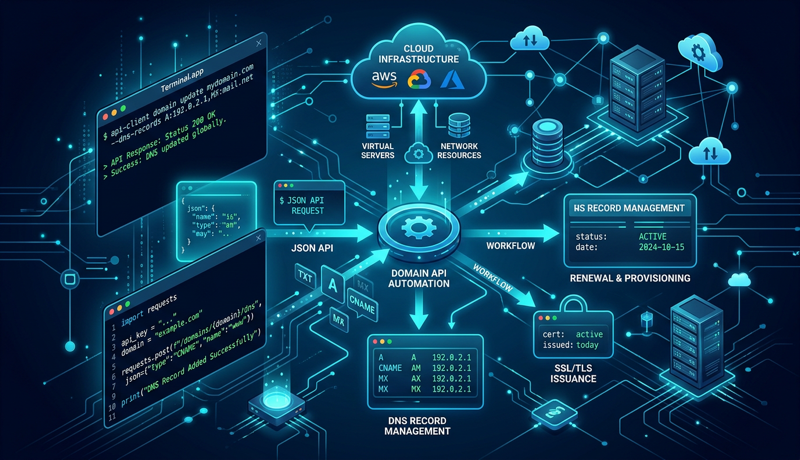
When your domain portfolio exceeds a certain size, manual operations become both inefficient and error-prone. Through registrar and DNS service APIs, you can automate domain management with code — from bulk DNS updates to automated renewal decisions.
Why Automate Domain Management
Manual Management Pain Points
- Logging into multiple registrar dashboards for individual changes
- DNS changes require manual login, modification, confirmation
- Bulk changes across dozens of domains take hours
- Human errors (like accidentally deleting records)
- Impossible to enforce consistent management standards
Automation Value
- Efficiency: Bulk operations go from hours to seconds
- Fewer errors: Programmatic execution is more precise than manual
- Standardization: All domains follow the same configuration standards
- Auditable: Automated operations leave logs for traceability
- DevOps integration: Domain management fits into automated ops workflows
Major Registrar API Overview
Cloudflare API
Comprehensive DNS and domain management: DNS record CRUD, bulk management, SSL certificates, firewall rules, domain registration/transfer. RESTful with Token auth, excellent documentation, free tier access.
GoDaddy API
Domain search/registration, DNS management, renewal/transfer, WHOIS updates. RESTful with API Key + Secret auth, OTE test environment, strict rate limits.
AWS Route 53 API
DNS zone management, record CRUD, health checks, traffic policies. AWS SDK support (boto3), IAM permissions, deep AWS integration.
Namecheap API
Domain registration/renewal, DNS management, WHOIS updates, SSL. XML format (not JSON), requires API access approval, IP whitelist restriction.
Common Automation Scenarios
Scenario 1: Bulk DNS Updates
When migrating servers across multiple domains:
- Read domain list and target configuration
- Iterate through each domain
- Fetch current DNS records via API
- Update records that need modification
- Verify changes took effect
- Log all operations
Scenario 2: New Domain Auto-Configuration
Automatically set up standard configuration after registration:
- Detect new domain registration
- Auto-set standard DNS records (A, MX, TXT, etc.)
- Enable domain lock
- Configure privacy protection
- Add to monitoring system
- Update asset inventory
Scenario 3: SSL Certificate Auto-Management
Using Let’s Encrypt for automatic certificate management:
- Monitor certificate expiry
- Auto-renew 30 days before expiry
- Complete domain validation via DNS API (DNS-01 challenge)
- Deploy new certificate to server
- Verify configuration
- Send success notification
Scenario 4: Automated Renewal Decisions
Rule-based automatic renewal handling:
- Class A domains: Auto-renew without approval
- Class B domains: Send approval notification, await confirmation
- Class C domains: Send expiry reminder, default to no renewal
Security Best Practices
API Key Management
- Least-privilege principle — grant only necessary permissions
- Never hardcode keys in scripts
- Use environment variables or secret management services
- Rotate keys regularly
- Use different keys for different purposes
Operational Safety
- Test in staging before production
- Add confirmation and rollback mechanisms for bulk operations
- Audit log all API operations
- Set rate limits to prevent accidental floods
- Require double confirmation for dangerous operations (deletions)
Tools and Frameworks
Terraform for DNS
Infrastructure-as-code DNS management: declarative configuration, change preview, Git version control, multi-provider support.
OctoDNS
Open-source DNS record synchronization: sync records across providers, YAML-based configuration, change preview, CI/CD integration.
Custom Scripts
For simple needs: Python + requests for REST APIs, official SDKs, cron jobs for scheduling.
Implementation Roadmap
Phase 1: Basic Automation
- Domain expiry monitoring scripts
- Automated DNS record backups
- API access and key management standards
Phase 2: Process Automation
- Auto-configuration for new domains
- Bulk DNS update capabilities
- SSL certificate auto-renewal
Phase 3: Intelligent Management
- Rule-based auto-renewal decisions
- Anomaly detection and auto-alerting
- CI/CD pipeline integration
Summary
Domain API automation is the inevitable direction for modern domain management. Through registrar and DNS APIs, bulk operations, standardized configuration, and automated monitoring dramatically improve efficiency while reducing human error. Follow security best practices — least privilege, key management, audit logs. Start with simple monitoring scripts and gradually expand to comprehensive automation. For teams managing more than 20 domains, API automation isn’t optional — it’s essential.