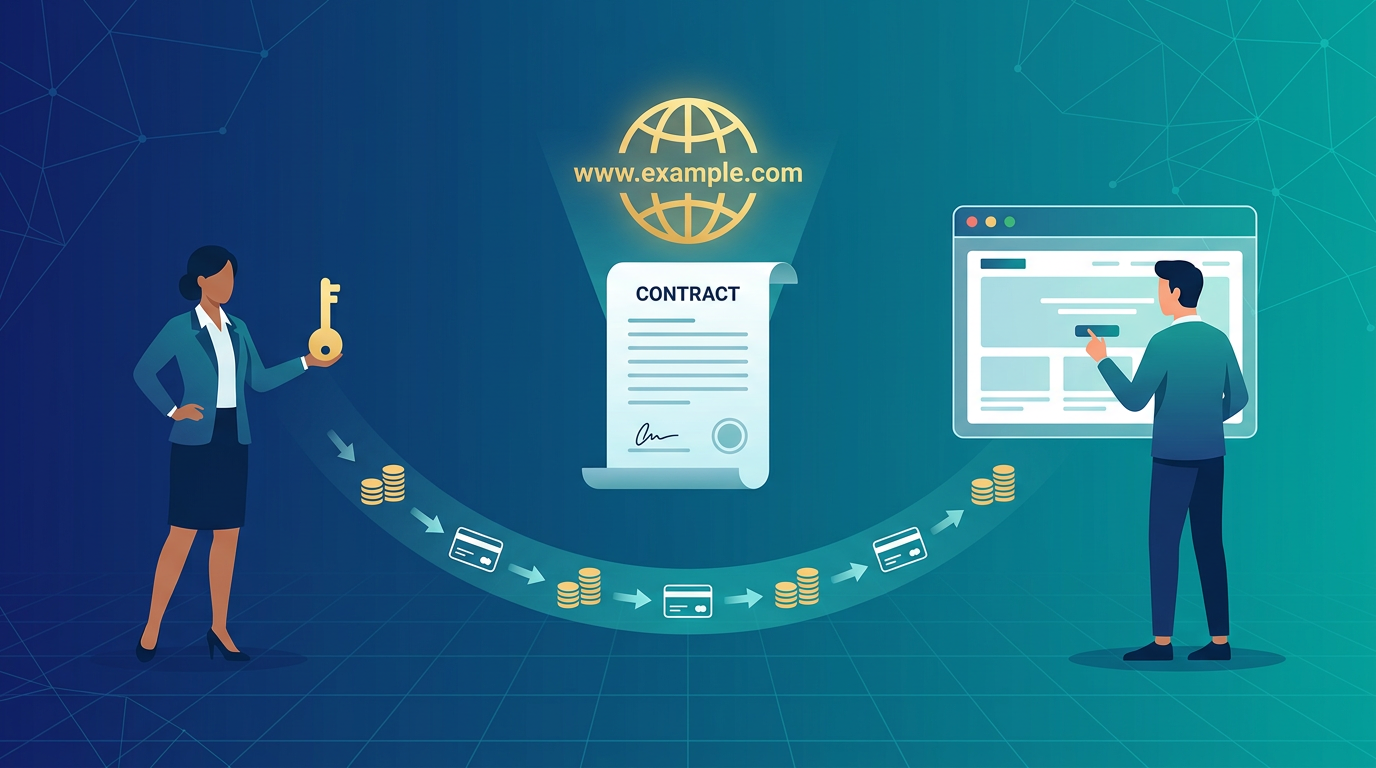
You own a domain worth $10,000. A startup wants it badly, but you believe it will appreciate further and you are not ready to sell. The buyer, meanwhile, cannot justify a five-figure lump sum for a brand they have not yet validated in the market.
The traditional choice is binary: sell now or hold indefinitely. Domain leasing introduces a third path. You retain full ownership while the lessee pays a monthly fee for usage rights. You generate recurring income, the lessee gets a premium brand domain without massive upfront capital, and both sides benefit from a flexible arrangement.
This guide covers everything you need to know about domain leasing—from pricing models and contract essentials to platform selection and risk management—whether you are the domain investor looking to monetize your portfolio or the entrepreneur searching for a competitive brand name.
What Domain Leasing Actually Is
Domain leasing is the practice of granting temporary usage rights to a domain name in exchange for periodic payments, typically monthly or quarterly. The registrant (owner) remains unchanged throughout the lease term. The lessee receives DNS control to point the domain to their website, email servers, or other services, but never gains registrant-level authority over the domain itself.
The analogy to commercial real estate is precise. A landlord retains the deed to a property while a tenant pays rent for occupancy. When the lease expires, the tenant either renews, exercises a buyout option if one exists, or vacates—returning full control to the owner.
In the domain world, “vacating” means the lessor reclaims DNS settings, and the domain either goes back to a parking page or becomes available for the next lessee or buyer.
Leasing vs Selling: The Financial Case
The decision between leasing and selling comes down to whether you prioritize immediate liquidity or long-term yield. Consider a domain appraised at $10,000:
If you sell outright, you receive approximately $9,000 to $9,100 after typical marketplace commissions of 9-15%. The transaction is complete, and you permanently lose the asset. Should the domain appreciate to $50,000 in three years due to industry trends, that upside belongs entirely to the new owner.
If you lease the same domain at $250 per month—a figure well within typical range for a five-figure domain—you collect $12,000 over four years. That is $3,000 more than the sale price, and you still own the domain at the end of the lease. If the domain has appreciated during that period, you retain that upside as well. You can lease it again, sell it at the higher valuation, or continue holding.
The tradeoff is time and risk. Leasing income arrives gradually. The lessee might default after six months. You bear the administrative overhead of managing the relationship. But for investors with portfolios of premium domains they believe will appreciate, leasing converts dormant assets into cash-flowing instruments without sacrificing long-term positioning.
Who Benefits from Domain Leasing
Domain leasing serves two distinct parties whose interests align naturally.
For domain investors and portfolio holders, leasing transforms holding costs into positive cash flow. Annual renewal fees, which range from $10 to several hundred dollars for premium extensions, are easily covered by a single month’s lease payment. More importantly, leasing allows investors to monetize domains they are not yet willing to sell—either because they expect appreciation, because the current market does not reflect the domain’s true value, or because they prefer predictable recurring income over one-time windfalls.
For businesses and startups, leasing removes the single largest barrier to acquiring a premium domain: the upfront cost. A bootstrapped SaaS company that cannot justify spending $15,000 on a domain before achieving product-market fit can lease that same domain for $300 per month—testing the brand, building SEO authority, and proving traction before committing to a full acquisition. Many lease agreements include a buyout option, effectively functioning as a rent-to-own arrangement where a portion of monthly payments may be credited toward the final purchase price.
Pricing Strategies for Domain Leases
Setting the right lease price requires balancing market value, lessee affordability, and your own return expectations. Several established frameworks exist.
The most common approach uses a percentage of appraised value, typically 1.5% to 3% of the domain’s estimated market value per month. A domain valued at $10,000 would therefore lease for $150 to $300 monthly. Domains with stronger commercial utility or higher type-in traffic often command the upper end of this range.
Industry advertising cost benchmarking offers another lens. If the domain targets a keyword where Google Ads cost-per-click runs $8 to $15, a premium exact-match domain delivering organic traffic has clear economic value that can justify a higher monthly rate. Lessees in competitive industries like insurance, legal services, or real estate are accustomed to high customer acquisition costs and may accept lease rates that reflect those economics.
Tiered pricing structures reward longer commitments. You might offer $300 per month on a 12-month lease, $250 per month for 24 months, or $200 per month for a 36-month commitment. This incentivizes longer terms—which means more predictable revenue for you—while giving the lessee a tangible discount for the commitment.
Lease-to-own arrangements add a purchase option. A common structure applies 50% to 70% of lease payments toward a predetermined buyout price. For example, a domain listed at $12,000 might lease at $300 per month with $200 of each payment credited toward the purchase. After 36 months, the lessee has accumulated $7,200 in credit and can acquire the domain for the remaining $4,800. This model is particularly attractive to lessees because it eliminates the feeling of “throwing money away” on rent.
Essential Contract Terms
A well-drafted domain lease agreement protects both parties and prevents disputes. The following terms are non-negotiable.
Lease duration should be clearly stated, typically ranging from 12 to 36 months. Shorter terms favor the lessor’s flexibility; longer terms provide more security for both sides. Include explicit renewal terms—whether renewal is automatic, requires mutual agreement, or offers the lessee a right of first refusal.
Payment terms must specify the amount, frequency, due date, accepted payment methods, and consequences of late payment. Most agreements include a grace period of 5 to 10 days, followed by a late fee, and an automatic termination trigger if payment remains outstanding beyond 30 days.
DNS control and technical access defines exactly what the lessee can do. Typically, the lessee receives the ability to modify DNS records (A, CNAME, MX, TXT) to point the domain to their infrastructure. The registrar account, transfer lock, and WHOIS registrant information remain under the lessor’s exclusive control. Spell this out explicitly to prevent misunderstandings.
Usage restrictions protect the lessor’s asset. Prohibit illegal activity, content that could damage the domain’s reputation, and uses that might trigger trademark disputes or spam blacklisting. Some lessors also restrict subleasing.
Early termination provisions address what happens when either party wants to exit before the lease concludes. Common approaches include requiring 30 to 60 days written notice from the lessee with forfeiture of that month’s payment, or allowing the lessor to terminate with 90 days notice if they receive a qualified purchase offer (sometimes with a matching-right clause for the lessee).
Buyout options, if offered, should specify the purchase price or pricing formula, the window during which the option can be exercised, and how previously paid lease amounts are credited.
Post-expiry handling clarifies what happens when the lease ends without renewal or buyout. The lessee must relinquish DNS control within a specified timeframe (typically 7 to 14 days), remove the domain from all marketing materials within 30 days, and set up 301 redirects if agreed upon.
Platforms and Marketplaces
Several platforms facilitate domain leasing, each with different strengths.
Dan.com is the most established platform for lease-to-own transactions. Their system handles payment collection, installment tracking, and automatic domain transfer upon completion. Dan.com charges a 9% commission on successful transactions. The platform excels at structured lease-to-own deals but offers less flexibility for pure leasing arrangements where no ownership transfer is intended.
GoDaddy offers domain installment payment plans through its aftermarket, functioning similarly to lease-to-own. As the world’s largest domain registrar, GoDaddy brings massive buyer traffic, though its commission structure and interface are more geared toward outright sales.
Efty provides portfolio management tools that support lease listings alongside traditional sales. Its landing page system and lead capture tools make it well-suited for investors who want to offer leasing as one option alongside outright purchase, letting the buyer choose their preferred arrangement.
Private negotiation remains the dominant channel for high-value domain leases (typically above $20,000 in domain value). At this level, both parties usually engage attorneys to draft bespoke agreements. Private deals eliminate platform commissions entirely and allow maximum flexibility in structuring terms, payment schedules, and buyout provisions.
Step-by-Step Process
For the lessor, the process begins with identifying leasable domains in your portfolio—those with clear commercial value that you are not willing to sell at current market prices. Determine your target lease rate using the pricing frameworks above. Create a professional landing page or marketplace listing that explicitly advertises leasing as an option. When inquiries arrive, qualify the lessee (verify their intended use, business legitimacy, and payment capacity), negotiate terms, and execute a formal agreement. Set up automated payment collection through your chosen platform or payment processor, configure DNS access for the lessee, and establish a monitoring schedule to ensure contract compliance.
For the lessee, start by identifying target domains and confirming they are available for lease (look for “lease” or “rent” options on landing pages, or contact the owner directly via WHOIS). Evaluate whether the monthly cost is justified by the brand value, SEO benefit, or customer acquisition advantage the domain provides. Negotiate terms—especially lease duration, buyout options, and what happens to any SEO equity you build if the lease ends. Execute the agreement, configure DNS to point to your infrastructure, and begin building on the domain while honoring all contractual usage restrictions.
Risks and Mitigation
Payment default is the most common risk for lessors. Mitigate this by requiring the first and last month’s payment upfront as a deposit, using automated payment collection with clear escalation procedures, and structuring the contract so DNS reverts to your control immediately upon confirmed default.
Reputation damage can occur if the lessee uses the domain for spam, adult content, or other activities that get the domain blacklisted or penalized. Detailed usage restrictions in the contract, combined with periodic monitoring of the domain’s reputation through tools like Google Safe Browsing and email blacklist checks, provide early warning of problems.
SEO attribution after lease expiry creates a complex situation. If the lessee builds significant organic search rankings during the lease, those rankings are tied to the domain—which you reclaim. The lessee loses that SEO equity, which can create disputes. Address this proactively in the contract by clarifying that all SEO value accruing to the domain belongs to the domain owner, and offering the lessee a 301-redirect grace period of 60 to 90 days after lease termination to migrate traffic to their new domain.
Cross-border legal issues arise when lessor and lessee are in different jurisdictions. Currency fluctuation, conflicting contract law, and enforcement difficulties add complexity. Specify governing law and jurisdiction in the contract, use internationally recognized payment processors, and consider escrow services for high-value leases.
Frequently Asked Questions
How does domain leasing differ from installment payments?
Installment payments (or payment plans) are a purchase structured over time—ownership transfers upon final payment. Leasing grants temporary usage rights with no ownership transfer unless a buyout option is separately exercised. The critical distinction is intent: installments always result in ownership transfer, while a lease may end with the domain reverting to the original owner.
What is a typical monthly lease rate?
Most domain leases fall between 1.5% and 3% of the domain’s appraised market value per month. A $5,000 domain typically leases for $75 to $150 monthly, while a $50,000 domain might command $750 to $1,500 per month. Exact rates depend on the domain’s commercial utility, the industry it serves, and prevailing market conditions.
Who appears in WHOIS during a lease?
The original owner (lessor) remains the registered owner in WHOIS throughout the lease term. This is a fundamental protection for the lessor—it prevents unauthorized transfers and confirms continued ownership. The lessee’s information does not appear in WHOIS unless the domain is formally transferred through a buyout.
Can a leased domain be challenged through UDRP?
Yes. The Uniform Domain-Name Dispute-Resolution Policy evaluates the registrant’s rights and legitimate interests. Since the lessor remains the registrant, they bear the UDRP risk. However, if the lessee uses the domain in a manner that infringes a third party’s trademark, the resulting UDRP complaint targets the lessor as registrant. This underscores the importance of usage restriction clauses and selecting lessees who intend legitimate, non-infringing use.
Conclusion
Domain leasing occupies a strategic middle ground between holding domains passively and selling them outright. For investors, it converts static assets into income-generating instruments while preserving long-term appreciation potential. For businesses, it democratizes access to premium domains by replacing prohibitive lump sums with manageable monthly payments.
The model works best when both parties approach it professionally—with clear contracts, realistic pricing, and mutual understanding of the arrangement’s temporary nature. Whether you use an established platform like Dan.com for structured lease-to-own deals or negotiate privately for maximum flexibility, the key is treating domain leasing as what it is: a commercial real estate transaction that happens to involve digital property instead of physical space.