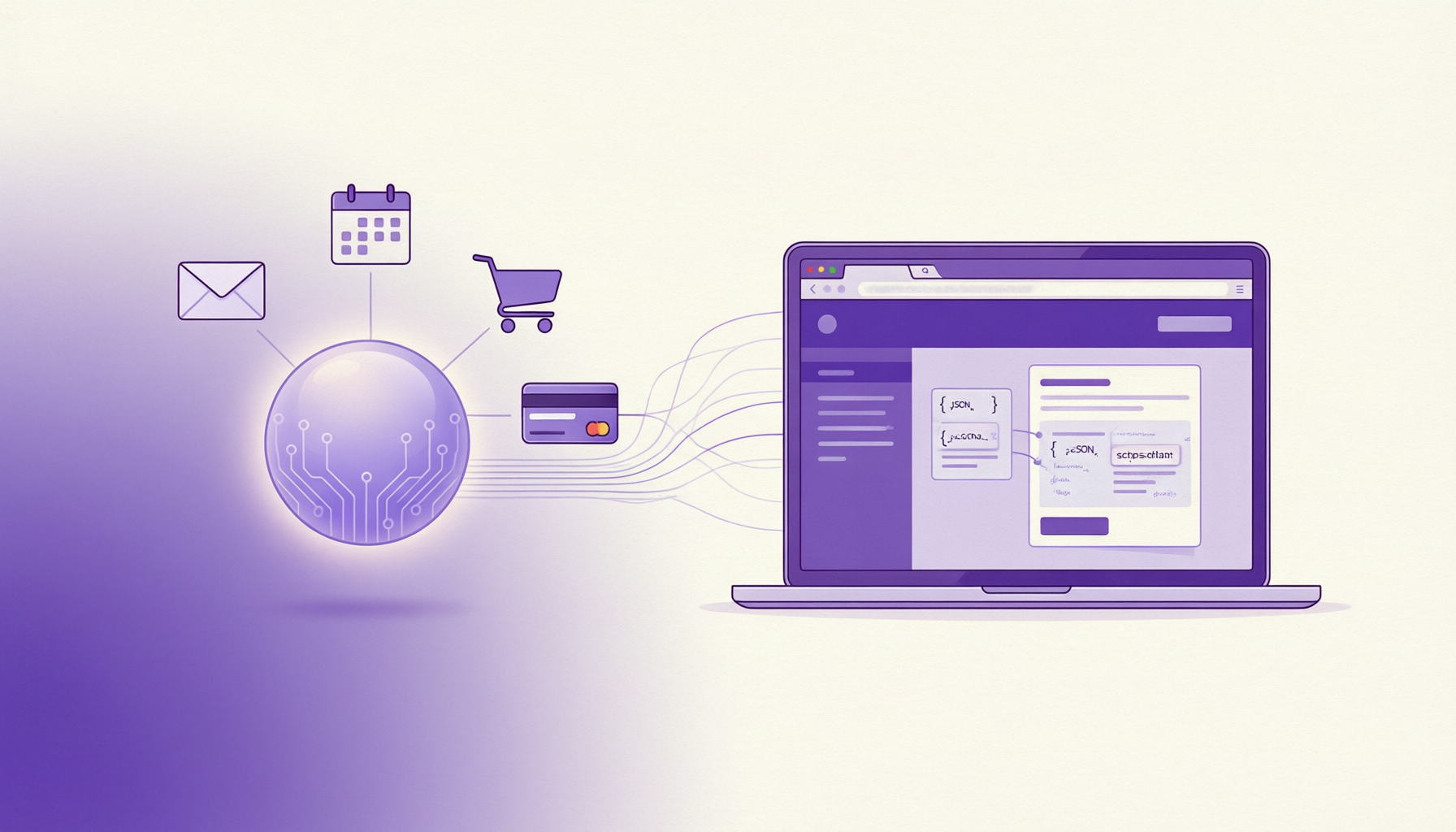
Meta launched Muse on September 8, 2026 — a personal AI agent that lives on iOS, Android, muse.ai, and WhatsApp, and can browse the web, fill out forms, send emails, book travel, and complete checkouts on a user’s behalf. Meta calls it “the world’s first personal AI agent built for everyone.” The Power tier costs $20/month for 500M tokens per week; the $100/month Maximum tier bumps that to 3B. Payments run through one-time Link by Stripe cards. Shop Pay and 1Password support are already on the roadmap.
For consumers, that’s convenience. For small and mid-sized businesses, it’s a structural shift in how customers find you, evaluate you, and pay you.
Here’s why: when a Muse-style agent is doing the searching, comparing, and clicking, you’re no longer optimizing for a human eyeball scanning ten blue links. You’re optimizing for a machine that reads your DOM, evaluates your trust signals, and decides whether your business is safe and structured enough to hand a customer’s payment credentials to.
Ranking is now the easy part. Being actionable by an agent is the new battleground.
What Meta Muse Actually Does — and Why It Changes Discovery
According to Meta’s official announcement and independent technical analyses, Muse can:
- Browse the web autonomously inside a sandboxed “Muse Secure VM”
- Fill in online forms and complete checkouts (asking for user approval before sensitive actions)
- Send emails, book travel, and schedule reminders across connected services
- Keep working in the background after the user closes the app
- Interact with services the user connects — email, calendar, payments, shopping, dining, fitness
The last bullet matters most for SMBs. Muse doesn’t crawl the web like Googlebot and rank it. It acts on the web like a customer. That means your website now has to work for a non-human visitor that:
- Reads structure, not vibes
- Is trained to fear prompt injection (Meta itself calls it “an open problem across the industry”)
- Needs to trust your domain enough to enter a one-time payment card
If your site was built for humans skimming a hero image, an agent will skim right past it — or worse, flag it as unsafe and route the customer to a competitor.
The 7 Website Fixes That Decide Whether AI Agents Choose You
These are the seven audits I’d run on any SMB site this quarter, in priority order.
1. A clean, brandable domain. Agents weigh domain trust heavily. A .com with your exact brand name — no hyphens, no numbers, no keyword stuffing — signals legitimacy faster than any on-page copy. If you’re still on a .xyz you picked because it was $1, or worse, a subdomain of a marketplace, you’re leaking trust before the agent even parses your H1.
2. Machine-readable structured data. Add Organization, Product, LocalBusiness, and FAQPage schema (schema.org / JSON-LD). This is no longer just an SEO tactic — it’s an agent tactic. Muse-style agents use structured data to extract prices, availability, and business identity without guessing from HTML.
3. Fast, mobile-first, HTTPS. Core Web Vitals matter more, not less, because agents time out faster than humans. Target LCP under 2.5s on 4G, no intrusive interstitials, TLS 1.2+.
4. Transparent pricing and product info in the HTML. Not behind a JavaScript-only modal. Not gated by “call for a quote” if you want agent-driven checkout. Real prices, real SKUs, real inventory status — in the initial DOM.
5. Simple, standard forms. Autofill-friendly field names (email, phone, address-line1), proper <label> tags, and no CAPTCHA walls that block non-human traffic without an alternative path. Consider exposing an MCP-compatible endpoint or a lightweight API for high-volume agents — this is where the ecosystem is heading.
6. Consistent NAP + business info. Name, address, phone — identical across your site, Google Business Profile, Bing Places, and major directories. Agents cross-check. Mismatches translate directly into trust penalties.
7. An explicit AI-agent policy. Publish an /ai-policy page or an llms.txt file stating what agents can and cannot do on your site. Yes, this is emerging — and it’s exactly the kind of signal a security-conscious agent running inside a “Secure VM” is trained to look for.
The Domain Layer: The First Signal Any AI Agent Evaluates
Here’s what most SMBs miss: your domain is the first piece of data any agent inspects. Before it renders your hero image, before it reads a line of copy, it checks:
- Is the TLD reputable? (
.com,.org,.net, and established country-code TLDs pass; most cheap new gTLDs raise fraud flags) - Does the domain match the brand name declared in your schema?
- How old is the domain? Freshly registered + high-volume checkout = red flag for every major fraud-detection system
- Is WHOIS privacy enabled, with a consistent registrant organization behind it?
If you’re launching a new brand in 2026 and want agent traffic, buy the .com if at all possible. If it’s taken, buy the closest ownable variant — get[brand].com, [brand]app.com, or [brand].co — not a string of hyphens and keywords.
NamesLink currently runs .com registrations at $5.88 for the first year (standard $10.88 renewal), includes free WHOIS privacy across all 158 supported TLDs, and shows the full renewal price before checkout — no bait-and-switch. For an SMB launching an agent-ready brand, that’s the cheapest trust signal money can buy.
Fast Path: Ship an Agent-Ready Site in One Afternoon
You don’t need a dev team to be Muse-ready. You need three things:
- A domain — registered with clean WHOIS, HTTPS enabled, and pointed at a real site (not a parked page)
- A structured website — with schema markup, real content, and standard forms
- Consistent business info — synced to Google Business Profile and Bing Places
If you’re starting from zero, LinkRaft AI Website Builder generates a clean, mobile-optimized site with schema pre-configured in under 90 seconds. Paste your value proposition, pick a template, publish. Then register the matching domain at NamesLink and point DNS. Total time: about an hour. Total cost: less than a single Google Ads click in most verticals.
The alternative — spending three months on a custom build while agents start routing purchases to competitors — is a much bigger bet than most SMBs can afford.
FAQ: Meta Muse AI and Your Business Website
Q: Is Meta Muse available worldwide? A: No. As of September 2026, Muse is rolling out in the United States only, with broader availability expected in 2027. But similar agents — ChatGPT Agent, Google’s Project Mariner, Perplexity Comet — are already global. Prepare once, benefit everywhere.
Q: Does Muse replace Google Search for consumers? A: Not yet. But it changes the last mile of the buying journey. Even if a customer finds you via Google, they may delegate the “compare, fill cart, checkout” steps to an agent — and that agent will re-evaluate your site on its own terms.
Q: Should I allow AI agents to crawl and act on my site?
A: Decide deliberately. Blocking all AI traffic with an aggressive robots.txt means losing agent-driven sales. Allowing everything with no policy means higher prompt-injection risk. Publish a clear AI policy and enforce it technically.
Q: Will Muse work with any e-commerce platform? A: Muse uses standard web browsing and form-filling, so it works with any site that has clean HTML forms. Shopify, WooCommerce, and custom stacks all function — but sites with heavy JavaScript-only checkout flows fail more often.
Q: What’s the single highest-ROI fix I can make this week?
A: Add Organization and Product JSON-LD schema to your homepage and product pages. Free, roughly 30 minutes of work, and immediately machine-readable by every major AI agent on the market.
Bottom Line
Meta Muse is not a novelty. It’s the first mainstream AI agent with payments, browsing, and background execution baked in — and it landed inside an app family that already reaches more than three billion people. The agentic web is here.
SMBs that treat their website as a brochure will lose visibility. SMBs that treat it as an API surface for machines — with a trustworthy domain, structured data, fast loading, and clean forms — will get chosen by agents that are increasingly doing the choosing.
Start with the domain. Fix the structure. Ship the site. Then let the agents come.
Ready to launch an agent-ready brand? Register your .com at NamesLink ($5.88 first year, free WHOIS privacy on 158 TLDs), then build the site in minutes with LinkRaft AI.